The paper that taught the world online dating: Whitty and Carr, revisited
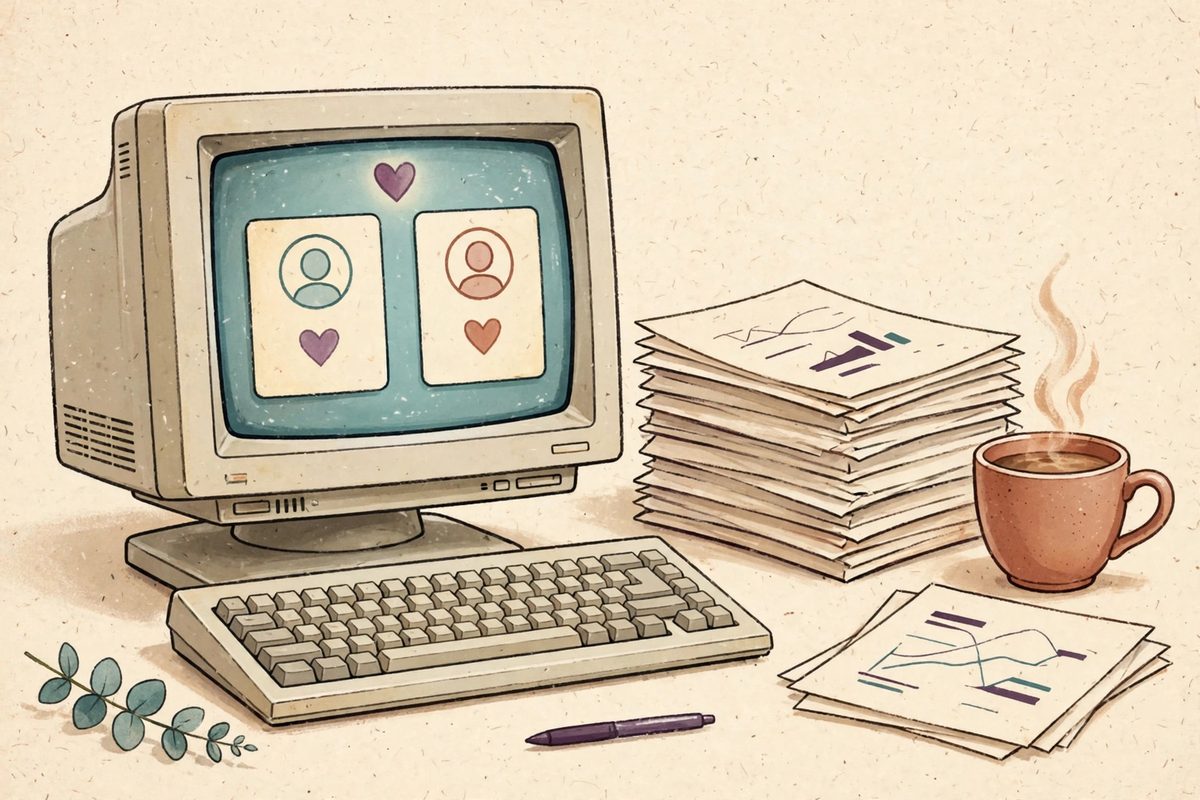
Writing in 2006, when meeting a partner online was still treated as a curiosity, Whitty and Carr sketched the whole process, from profile to first meeting. Much of it still describes your feed.
The short version
- Whitty and Carr mapped online dating as a process: profile, contact, conversation, meeting, each stage with its own risks.
- Their treatment of self-presentation was balanced: profiles bend the truth, usually in the direction of hope rather than fraud.
- The apps changed the machinery. The stages, and the psychology inside them, stayed recognisably the same.
A field guide written at the beginning
In 2006, online dating occupied an odd position: millions of people were doing it and many of them were still slightly embarrassed to say so. Whitty and Carr wrote about internet romance when it needed explaining from first principles, and that timing is exactly why their work is still worth reading. They had to describe every step that a modern app now hides behind a swipe.
Their account follows the process in order. A person builds a profile. Strangers make contact. Conversation develops, sometimes quickly into intimacy. At some point the relationship either moves toward a meeting or quietly ends. Each stage, they argued, has its own psychology, and confusing the stages is where much of the pain of online dating lives.
The profile problem
The profile was their first subject, because it is the first problem: a person must compress themselves into photographs and text, knowing strangers will judge in seconds. Whitty and Carr treated this neither as vanity nor as fraud. Self-presentation online is a performance, but so is a first date in a coffee shop. The screen changes the tools, not the impulse.
On deception, their position has aged well. Lies in profiles exist and some are serious, but the common case is smaller and sadder: people present the self they hope to become, or the self of a few years ago, and the gap is discovered in person, where it hurts more. Later research on profile accuracy has largely confirmed that balance.
Safety, stigma and the move offline
Writing before dating apps normalised the whole practice, they took safety seriously without hysteria: the risks of meeting strangers are real, manageable, and shared with plenty of offline ways of meeting people. They also documented the stigma of the era, the assumption that online daters were desperate or deceptive, which reads now like a dispatch from another culture.
The move from screen to meeting was, for them, the hinge of the whole process. Online chemistry is genuine but incomplete, built from text, timing and imagination. A meeting does not test the online relationship so much as start a second one, which has to be reconciled with the first.
What the apps changed, and what they did not
The machinery has been rebuilt several times since 2006: location-based apps, algorithmic matching, video calls, verification badges against the photo problem they described. What has not changed is the sequence inside the person. Hope, presentation, interpretation, disappointment or delight, and the decision about whether a stranger is becoming someone.
That is why this paper is still assigned and still cited, and why its full text sits in this site's archive. It is a map drawn when the territory was new, by two researchers who bothered to walk the whole route.
What the paper cannot prove
A 2006 account of dating websites cannot describe app culture, and its examples predate smartphones entirely. Read it for the structure of online relating rather than for any claim about today's platforms, and read newer work alongside it for the mechanics of the swipe era.
Go to the source
Based on Whitty and Carr (2006), on the internet and relationships. The archive keeps the journal's early volumes reachable at the addresses their citations use.
Find the Whitty and Carr full text in the archiveAlso read
 Attachment
Your responses guide me: when replies ease attachment anxiety
A study of people building relationships online, message by message, found that a partner's replies did something quietly remarkable: over time, their attachment anxiety fell.
Read the explainerRomantic RelationshipsWhat mixed race couples know that research is still catching up to
Mixed race couples negotiate identity, family and the public gaze as part of ordinary life. The archive's research on multiracial identity, and the scholars who keep citing it, show what that teaches everyone else.
Read the explainerFiled under Dating and Online Dating.